Walk into almost any health food store or pharmacy and you’ll find an entire wall of supplements.
Different brands. Different forms. Different doses. Different claims.
It can be a lot to take in.
And while you may hear that “practitioner-grade” supplements are automatically better than the ones you find at a grocery store or pharmacy, I don’t think it’s quite that simple.
The brand or the place you buy a supplement isn’t the whole story. What’s inside the bottle matters.
Here are a few things I look at when choosing a supplement.
1. Look for an NPN
If you’re buying a natural health product in Canada, one of the first things I look for is an NPN - Natural Product Number.
Natural health products sold in Canada require a product licence from Health Canada, and licensed products carry an eight-digit NPN on the label. Health Canada assesses licensed products for quality, safety and efficacy according to their authorized conditions of use.
That doesn’t mean an NPN makes a supplement the right choice for you. It means the product has gone through Canada's regulatory process and has been authorized for sale.
You can also use Health Canada's Licensed Natural Health Products Database to check a product and its current licence status.
For me, that's a much more useful starting point than simply looking for the words "professional," "premium" or "practitioner-grade" on the bottle.
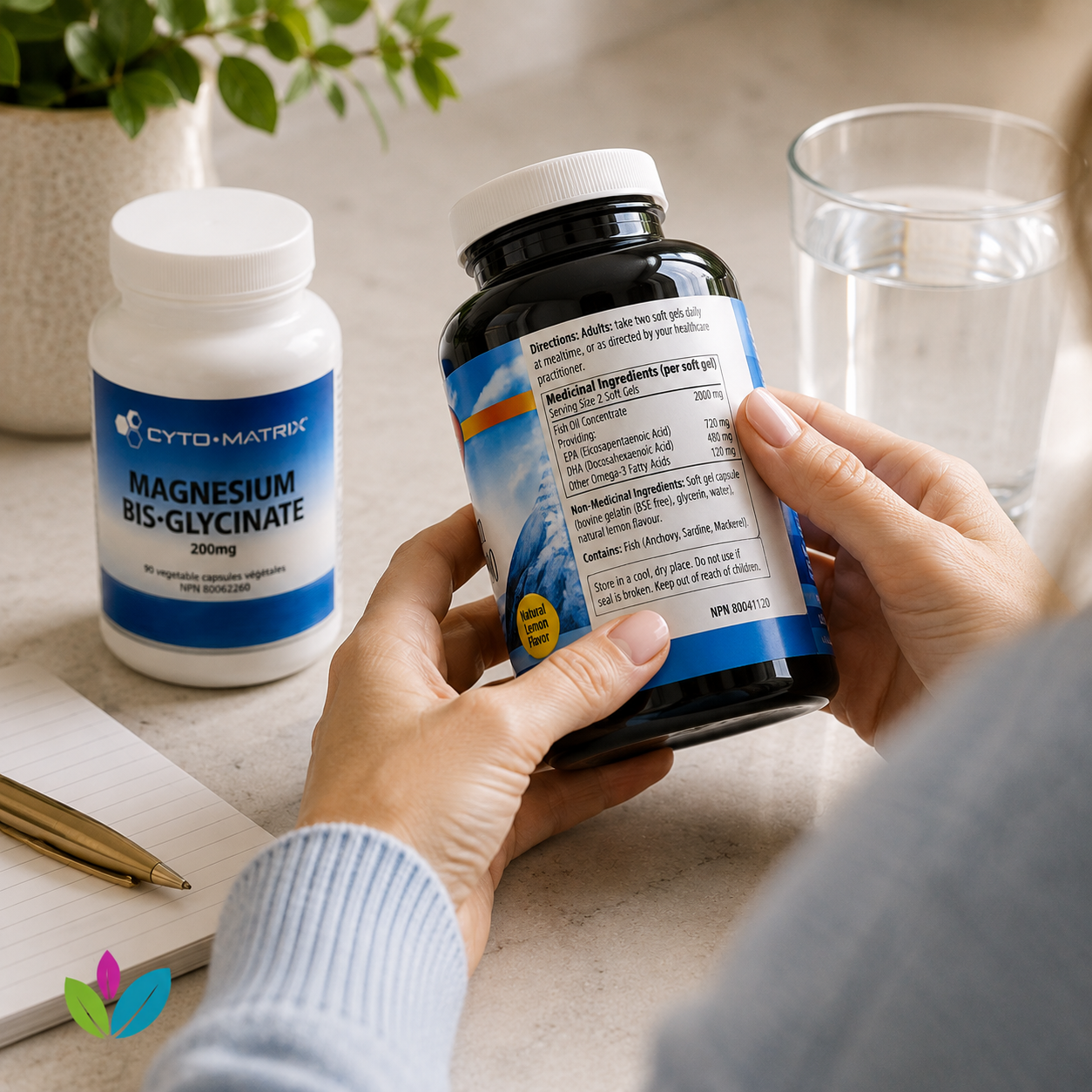
2. Read the actual label
Don't stop at the front of the bottle.
Turn it around and look at what's actually in it.
I want to know:
What are the active ingredients?
What form are they in?
How much is in each serving?
What other ingredients have been added?
What is the recommended use?
What is the suggested dose?
Are there warnings or precautions?
The details matter.
Two supplements can look very similar on the shelf and have quite different formulations once you actually read the labels.
3. More isn't necessarily better
This is one of the biggest traps in the supplement world.
A higher dose doesn't automatically mean a better supplement.
In fact, more of a nutrient isn't always appropriate or beneficial. Some nutrients can cause problems when taken in excessive amounts, and supplements can interact with medications or other supplements.
So I don't choose a product simply because it has the biggest number on the label.
I want the dose to make sense for the reason I'm taking it.
4. Consider the form of the nutrient
Sometimes the form of an ingredient matters.
Different forms of the same nutrient can differ in how they're absorbed, how they're tolerated and how they're used in the body.
That's one area where working with someone who understands supplements can be helpful. Instead of standing in front of a shelf wondering which of six versions to choose, you can have someone help you determine what actually makes sense for your particular situation.
But again, this isn't about finding the most expensive or most complicated product.
It's about choosing the right tool for the job.
5. Think about where you're buying it
There are good supplements sold in pharmacies, health food stores and other retail settings.
There are also good practitioner-dispensed products.
The fact that something is sold through a practitioner doesn't automatically make it superior, just as something being sold in a retail store doesn't automatically make it inferior.
What I care about is the quality of the individual product.
That includes the ingredients, formulation, dose, quality controls and regulatory status - not simply the sales channel.
6. Ask yourself whether you actually need it
This might be the most important question of all.
The supplement industry can make it feel as though everyone needs a cabinet full of bottles.
You don't.
Supplements can be useful in certain situations, but they aren't a substitute for the basics - eating well, getting enough sleep, moving your body, managing stress and taking care of the other everyday pieces of your health.
Before adding another bottle to the cupboard, ask:
Why am I taking this?
Is there a specific reason?
Is there a nutritional gap?
Has someone qualified recommended it?
Is there a reasonable amount of evidence behind its intended use?
And perhaps most importantly - do I still need it?
Sometimes the best supplement decision is deciding not to take another one.
What About Practitioner-Grade Supplements?
So, do I think practitioner-grade supplements can be worthwhile?
Absolutely.
There are some excellent practitioner-only products and companies that put a great deal of thought into their formulations and quality control.
They can also be useful when a practitioner is helping you choose a specific form, dose or combination based on your individual needs.
But I wouldn't tell you that practitioner-grade automatically means better.
I'd rather teach you what to look for.
Because once you understand how to read a label and what questions to ask, you can make much more informed decisions - whether you're standing in a pharmacy, a health food store or working with a practitioner.
A Little Less Supplement Overwhelm
You don't need to know everything about every supplement on the market.
You don't need ten different bottles because someone on social media told you they're essential.
And you don't need to buy the most expensive option to take your health seriously.
Start with the basics.
Know why you're taking something.
Look at the ingredients and dose.
Look for an NPN when you're buying a natural health product in Canada.
Consider the quality and formulation.
And make sure the supplement actually makes sense for you.
That's a much better place to start than simply asking, "What's the best supplement?"
Because the best supplement isn't necessarily the one with the fanciest label or the highest price.
It's the one that has a good reason to be in your cupboard in the first place.