Hormones can be confusing.
We hear about estrogen, progesterone, cortisol, insulin, thyroid hormones, testosterone, melatonin and "hormone balance" all the time. Then there are hormone tests, hormone replacement, adrenal fatigue, insulin resistance and endless advice about what we should be doing to "balance" our hormones.
It's a lot.
I've spent a long time learning about hormones, and even I think the way they're talked about online can make them sound much more complicated than they need to be. So let's take some of the mystery out of it and break it down in plain English.
You don't need to become a hormone expert. I'm going to keep it as simple as possible - because understanding the basics of what hormones are, what they do and how they work together can make a lot of this stuff easier to understand.
So, what exactly is a hormone?
A hormone is simply a chemical messenger.
Think of hormones as messengers carrying instructions from one part of your body to another. They travel through your blood and tell specific cells and tissues what to do.
Some help regulate blood sugar. Others are involved in reproduction, stress, sleep, metabolism, growth or bone health.
And they don't work alone.
Your hormones constantly respond to your sleep, food intake, activity, stress, age, menstrual cycle and stage of life. This is why I don't love the idea that we can simply "balance" our hormones with one food, supplement or routine.
Your hormones are supposed to change.
They change throughout the day. They change during your menstrual cycle. They change as you move through different stages of life.
The question isn't whether your hormones are changing. The question is what is changing, why is it changing, and how is it affecting you?
That's a much more useful way to think about hormones than simply trying to "balance" them.
Estrogen: much more than a reproductive hormone
Estrogen is probably the hormone women hear about most often.
Yes, it is important for your reproductive system and menstrual cycle, but that's not its only job. Estrogen also has important roles in your bones, brain, cardiovascular system, vaginal and urinary tissues.
During your reproductive years, estrogen naturally rises and falls throughout your menstrual cycle.
Then comes perimenopause, and things can get a little less predictable.
Estrogen doesn't just steadily drop. It can rise, fall and fluctuate quite a bit as your ovaries gradually become less consistent.
This is one reason you may notice changes that seem to come out of nowhere - a period that suddenly looks different, a hot flash you didn't have before, a change in sleep or a day when your mood or concentration just feels off.
It doesn't necessarily mean your estrogen is simply "too low." Your hormones may be changing in ways that are different from what you're used to.
Progesterone: the hormone that changes with your cycle
Progesterone follows a different pattern.
It rises after ovulation and helps prepare the lining of the uterus for a possible pregnancy.
So, if you aren't ovulating regularly, you aren't producing progesterone in the same way every cycle.
This is one of the reasons the hormonal changes of perimenopause can feel so unpredictable. Ovulation can become less consistent, which means progesterone can become less consistent too.
And estrogen and progesterone don't operate independently. What one is doing is happening alongside changes in the other.
Hormones can fluctuate rather than being simply "low" or "high."
That distinction is important because hormone conversations often make it sound like we should be able to look at one number and know exactly what is happening. In reality, the picture is usually more complicated than that.
This is also one reason you may hear a doctor say that hormone blood work isn't necessary in some situations.
It's not that blood work can't be useful. It can be very useful in the right circumstances. But a single hormone level is only a snapshot. Hormone levels can change throughout the day and, for some hormones, throughout the menstrual cycle. One number doesn't always tell you what is happening overall.
Sometimes your symptoms, menstrual history, age and the bigger picture tell us more than one blood test can.
Testosterone: yes, women have it too
Testosterone is often talked about as a "male hormone," but women produce testosterone too.
It plays a role in sexual function, bone health, muscle and other tissues.
Testosterone changes throughout life, and levels vary from person to person. It can be one piece of the picture when we're talking about things like libido, muscle, strength and overall well-being.
But just like estrogen and progesterone, it doesn't work on its own.
One hormone rarely explains everything.
Cortisol: your stress-response hormone
Cortisol gets a bad reputation.
You may have heard that cortisol is something we need to "lower," especially if you're stressed or having trouble sleeping. But cortisol isn't bad. You need it.
Cortisol helps your body deal with the things that come up during the day - a stressful conversation, a hard workout, being sick, or simply getting yourself going in the morning. It also helps with blood sugar, blood pressure and metabolism.
Think of it as part of your body's "okay, we've got something to deal with here" system.
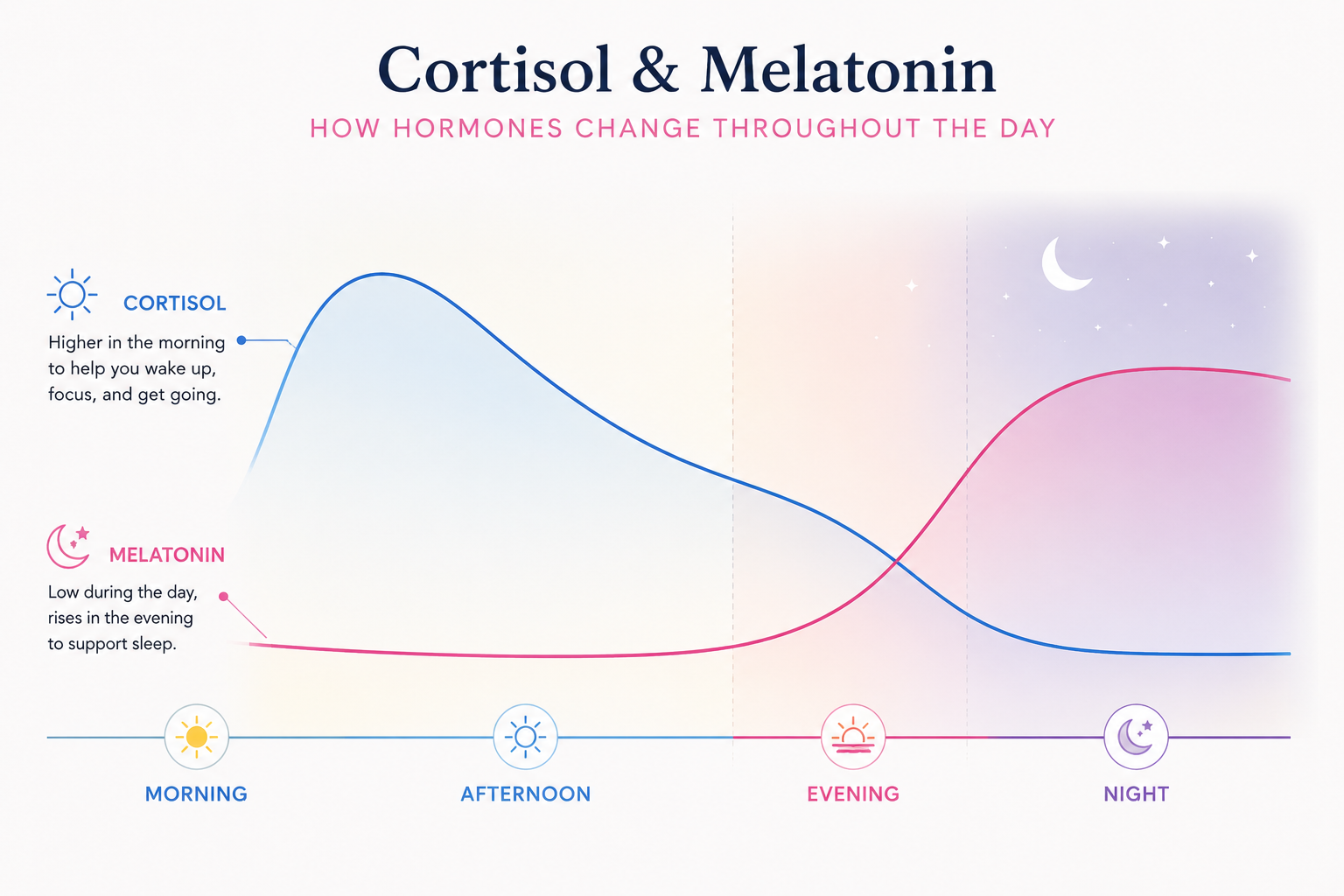
Cortisol also has a daily rhythm. It's generally higher earlier in the day and changes as the day goes on.
Cortisol and melatonin: two very different messages
Melatonin is one of the hormones involved in telling your body that it's nighttime.
As it gets dark, your body starts producing more melatonin, helping you wind down and prepare for sleep. Cortisol, on the other hand, is generally higher earlier in the day when your body is preparing to be awake and alert.
You can think of them as part of your body's day-and-night rhythm.
Morning says, "Let's get going."
Evening says, "Time to slow things down."
This is one reason things like morning light, dimmer light in the evening and a reasonably consistent sleep schedule can be helpful.
And if you're tired all the time, don't automatically assume cortisol is the problem. There are many reasons someone can feel tired, and persistent fatigue is worth looking at rather than trying to explain it with one hormone.
Thyroid hormones: the hormones that help regulate how your body uses energy
Your thyroid is a small gland in your neck that makes thyroid hormones.
These hormones help regulate how your body uses energy and affect things like metabolism, heart rate, body temperature and digestion.
When thyroid hormone levels are too low (hypothyroidism), you might experience things like fatigue, feeling cold, constipation or weight gain.
When thyroid hormone levels are too high (hyperthyroidism), you might feel unusually warm, have a racing heart, feel anxious or lose weight without trying.
And yes, if you're dealing with weight gain during perimenopause, I realize the idea of hyperthyroidism might sound pretty appealing. Unfortunately, an overactive thyroid is definitely not the weight-loss strategy I'd recommend!
Some thyroid symptoms can look a lot like things women experience during perimenopause, times of high stress or periods of poor sleep.
This is an important distinction.
A symptom can tell you that something has changed, but it can't tell you why it changed.
Take fatigue, for example. You could be tired because you're not sleeping well. You could be under a lot of stress. Your thyroid could be part of the picture. You could have a nutritional issue, be dealing with an illness, or be going through a hormonal change.
The symptom is the same - you're tired - but the reason behind it could be completely different.
That's why symptoms are useful. They give us clues. But they are only part of the story.
Insulin: the hormone that helps manage blood sugar
Insulin is another hormone we hear about all the time, especially when people are talking about blood sugar, cravings, energy or type 2 diabetes.
Let's start with what happens when you eat.
Your body breaks down some of the food you eat into glucose - a simple form of sugar that your body uses for energy. That glucose enters your bloodstream.
Your body needs to get that glucose out of your bloodstream and into your cells, where it can be used for energy or stored for later.
That's where insulin comes in.
Think of insulin as the helper that says, "There's fuel available - let's get it where it needs to go."
After you eat, insulin rises to help your body deal with the increase in blood sugar. Once that job is done, insulin generally comes back down.
Sometimes the body becomes less responsive to insulin. This is called insulin resistance. Over time, insulin resistance can contribute to type 2 diabetes, which is why good blood sugar regulation matters.
How well your body responds to insulin can be influenced by genetics, nutrition, physical activity, sleep and other factors.
Why do hormones get so confusing?
Because they don't work in separate little boxes.
Your hormones are constantly responding to one another and to what's happening in your body.
Poor sleep can affect how you feel during the day. Stress can affect your sleep. Changes in your menstrual cycle can affect how you feel. You may eat differently or exercise less because you're exhausted.
At the same time, your hormones may be changing too.
Which came first?
Sometimes there isn't a simple answer.
And this is especially true during perimenopause, when reproductive hormones can fluctuate and symptoms can be unpredictable.
That's why I don't think it is particularly helpful to look at one symptom and immediately decide that one hormone must be the problem.
The body is a connected system.
What happens to hormones during perimenopause?
Perimenopause is a good example of why hormones can be confusing.
Your ovaries don't simply turn off one day. As you move toward menopause, ovulation becomes less predictable and estrogen and progesterone can fluctuate.
Your periods may become irregular, you may start having hot flashes or night sweats, your sleep may change, and you may notice changes in your mood or concentration.
And just when you think you've finally figured out what's going on, things can change again.
Because apparently perimenopause likes to keep us guessing. 😂
This is one place where a simple visual can actually help. Seeing how estrogen and progesterone can fluctuate rather than simply decline makes the concept much easier to understand.
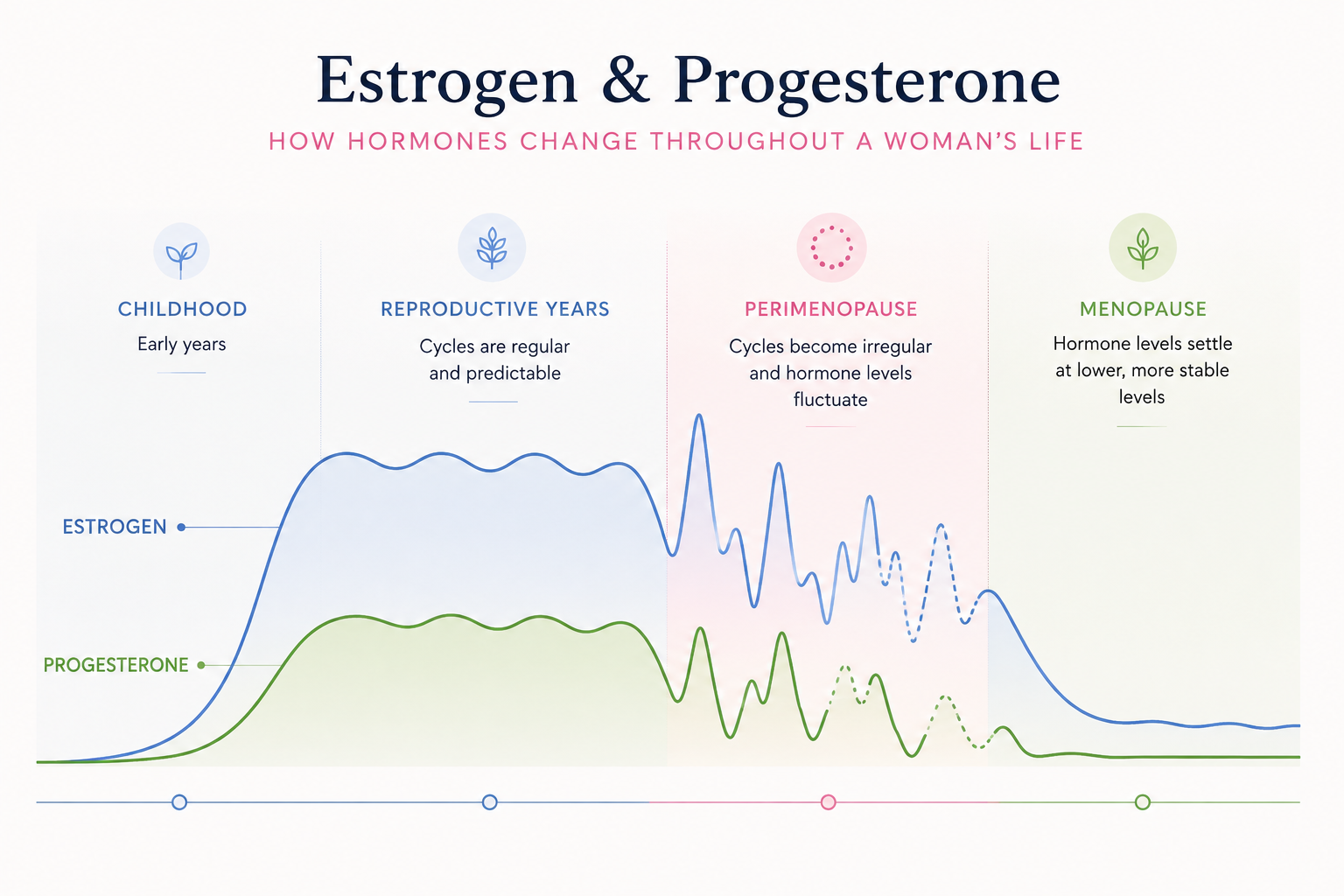
Menopause itself is reached after 12 consecutive months without a menstrual period. The transition leading up to it can involve a variety of changes and symptoms.
What should you do if you don't feel like yourself?
First, don't assume that everything is a hormone problem.
Start by getting curious.
Look at the bigger picture. Ask yourself:
How am I sleeping?
How is my energy throughout the day?
Are my periods changing?
Am I having hot flashes or night sweats?
Has my mood changed?
Has my stress level changed?
Am I eating differently?
Am I moving my body differently?
Have my medications or other health circumstances changed?
You don't need a complicated tracking system. Just start noticing what's happening and whether you can see any patterns.
And if something feels significantly different, persistent or disruptive, talk with your healthcare provider.
Sometimes hormones are part of the story. Sometimes they're not. And sometimes there are several things going on at once.
The bottom line
Hormones aren't something to fear, and they're not something you need to constantly "balance."
They're messengers. They change. They respond to what's happening in your body and around you, and they interact with one another all day long.
Rather than trying to figure out which hormone you need to "fix," start by paying attention to what has changed and looking at the bigger picture.
You don't have to figure it all out on your own. You just need to understand your body well enough to ask better questions, notice patterns and know when it's worth getting some help - and feel like you're part of the conversation.